Guide to Connecticut Marriage Records
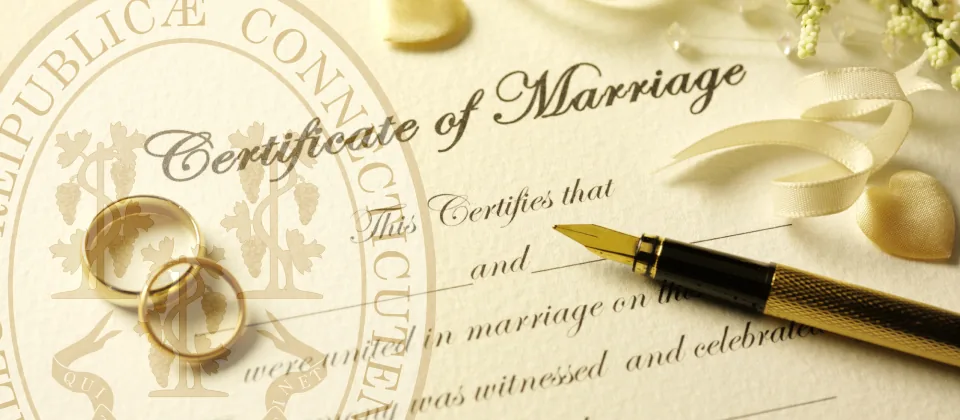
Marriage records are official documents signifying the formalization of marriages. They provide details about the couples' identities, including their names, the date and county of marriage, and the marriage officiant's signature.
A marriage record may be available as a marriage license or a marriage certificate. A marriage license is the document a couple receives before their wedding that authorizes them to marry. When the marriage takes place and the license is registered, it becomes a marriage certificate, the formal record of the marriage. The term 'marriage record' refers to any marriage-related documentation maintained in official archives.
Individuals look for Connecticut marriage records for many legal purposes, including proving their marital status for immigration, taxation, or spouse insurance enrollment. Besides this, genealogy researchers use marriage records to trace family histories.
Types of Marriage Records in Connecticut
| Record Type | Purpose | Issued By | Validation/Notes |
|---|---|---|---|
| Marriage license | Grants legal permission to marry. | Town clerk or vital records office. | Valid for 65 days. |
| Marriage certificate | Serves as official, permanent proof that a marriage took place. | Town Vital Records Office or Connecticut State Vital Records Office. | Certified copies are required for official name changes and legal benefits. |
| Historical marriage records | Genealogy, family history, and historical research. | Connecticut State Library, town archives, or town clerks (for records before July 1, 1897). | Availability and detail vary by town and era; some old entries are handwritten town-book entries rather than standardized certificates. |
The most commonly requested forms of marriage records in Connecticut include the following:
Marriage Certificates
A marriage certificate is the official document that is created once a valid marriage license has been issued by the officiant and submitted to the relevant registrar’s office in the town where the marriage ceremony was performed.
A typical marriage certificate contains the full names of both spouses (which includes their maiden names), the date and location of the marriage, the marriage license number, and the name of the officiant.
A certified copy of a marriage certificate is required when proof of marriage is needed for official or administrative purposes, such as a name change, a visa application, or a benefit claim.
Certified copies of marriage records can be obtained from the State Vital Records Office in the Department of Public Health (DPH) or the vital records office of the town where the marriage took place. Such copies may also be available from the vital records office of the town where at least one of the spouses resided at the time of the marriage.
Marriage Licenses
A Connecticut marriage license is a document obtained by a couple before a marriage that authorizes them to marry. It does not establish that the marriage actually occurred, but is issued before the ceremony as a permit to solemnize a marriage between two individuals.
Connecticut marriage-license applicants must obtain the license from the vital records office in the town where the marriage ceremony will take place. Under state law, the marriage license is valid for 65 days.
Are Marriage Records Public in Connecticut?
Connecticut marriage records are generally considered public records. Per Section 7-51a of Connecticut General Statutes, any individual aged 18 or older may purchase a certified copy of a marriage record from the relevant record custodian. Requesters do not have to be a spouse named on the record or an immediate family member to obtain access to marriage records.
While marriage records are public, not every detail on the records is available to all requesters. Sensitive information, such as Social Security numbers, is restricted from public access.
What Information Is Included in a Marriage Record?

The following details are typically available on a Connecticut marriage record:
- Full names of both spouses (including maiden names where applicable)
- Date and time of the marriage
- Place of marriage (city, town, or specific venue location)
- Ages or birth dates of both spouses at the time of marriage
- Places of residence for both spouses
- Name of the officiant who performed the ceremony
Older marriage records may contain additional information such as state file numbers, race, and nativity.
Note that Social Security Numbers (SSNs) of the spouses are redacted from public copies of marriage records and are only issued to the married parties themselves. Also, home addresses may be restricted in general public-access search engines to protect personal privacy.
How to Find Marriage Records in Connecticut
Step 1: Identify the Marriage Details
Start with the full names of the two spouses and the date of marriage. If it is possible, also identify the Connecticut town or city where the marriage took place. If the precise location is unavailable, determine where either spouse lived at the time of marriage. Copies of vital records were also retained in the Connecticut town where a spouse lived at the time of the event and, as such, can be used for further inquiries.
Step 2: Find the Record Custodian
The State Vital Records Office maintains records of marriages from July 1, 1897, to the present. A certified copy can also be obtained from the particular city where the marriage occurred or any town where either spouse lived at that time.
If a marriage occurred before July 1, 1897, contact the vital records registrar in the town of the marriage. Historical indexes and selected digitized materials are also available through the Connecticut State Library.
Step 3: Choose How to Search
Certified records can be obtained by mail or by visiting the relevant city or state vital records office. There is also an option to place orders online or by telephone, via VitalChek, the state's authorized vendor. However, additional processing and shipping charges apply to VitalChek orders.
Genealogists may access older records online through the Connecticut State Library's genealogy indexes, digital collections, and physical historical town records.
Step 4: Submit a Record Request
To obtain a certified copy of the marriage certificate, you must complete an official marriage certificate application and provide sufficient information to locate the record.
Regardless of whether the application is filed at the state or town level, a standard certified copy costs $20. Requests made at the local level are generally processed faster than those made at the state level. Processing requests made to the State Vital Records Office can take up to 12 weeks. However, VitalChek offers expedited processing for orders placed online through its services. Town processing times vary by municipality.
How to Get a Certified Marriage Certificate in Connecticut
Under state law, marriage records are public, and any individual who is at least 18 years old may request and purchase a standard certified copy of a marriage certificate. Hence, requesters must present a valid government-issued photo ID, such as a driver's license, state ID card, or passport, as proof of age.
Requests for a certified Connecticut marriage record can be made through:
- State Vital Records Office
- The town where the marriage occurred
- The town where either spouse lived when the marriage occurred
- VitalChek for online or telephone ordering
Applications can be submitted using the official State DPH application form or the specific municipality's vital records request form. Fees are generally around $20 per certified copy, whether requested from a town clerk or from the state, and some third-party services incur an additional processing fee.
Processing times differ significantly depending on where the request is filed. Town clerk offices can often issue a certified copy the same day for in-person requests, while mail-in or state-level requests through the DPH can take significantly longer, sometimes up to 12 weeks.
Certified copies obtained of marriage certificates can be used for legal name changes, passport applications, spousal benefit claims, immigration paperwork, and any other purpose where official proof of marriage is required.
How to Get a Marriage License in Connecticut
Couples planning to marry in Connecticut are required to apply for a marriage license at the vital records office in the town where the ceremony will take place. This is regardless of where either spouse resides. Typically, both applicants must appear in person, complete a marriage license application, provide valid identification, and make a sworn statement confirming the accuracy of the information provided.
Both parties applying for a marriage license must be at least 18 years old to be eligible to obtain the license. Furthermore, there is no state requirement, meaning that nonresidents can obtain a Connecticut marriage license provided the ceremony takes place in the state. The marriage license fee is $50.
Connecticut requires no waiting period for a marriage license applied for before October 1, 2026. However, under Public Act 26-141, after this date, registrars must wait at least 48 hours after the application before issuing a marriage license. A marriage must be performed no later than 65 days after the issuance of a marriage license.
Connecticut law authorizes a range of officiants for marriage ceremonies in the state. These include ordained clergy, judges, and certain other designated officials. The officiant must certify the fact, time, and place of the marriage and return the completed certificate to the registrar of the town where the marriage occurred. Once registered, it becomes the official marriage certificate.
Who Can Request Marriage Records?
Connecticut permits any person at least 18 years of age, including spouses, relatives, attorneys, genealogists, and unrelated individuals, to obtain a certified copy of a marriage record.
However, only certain persons entitled under Connecticut law can obtain a marriage record that includes the spouses’ Social Security numbers. These are the parties to the marriage and entities authorized by state or federal law.
Free and Online Marriage Record Searches

There are various official and unofficial sources for searching Connecticut marriage records at no cost. Usually, official state and county sources are the best for such searches, especially if the goal is to determine whether the record exists before paying for a certified copy.
For conducting historical research, the Connecticut State Library provides useful free resources, including the Barbour Collection of Connecticut Vital Records, Church Records Index, newspaper archives of marriage notices, family and Bible records.
Genealogy databases also provide access to older marriage records. For instance, FamilySearch provides an index of Connecticut marriage records and electronic images of documents for marriages between 1630 and 1997.
When using free resources, only limited information can be accessed, typically including identifying details like names, dates, and places. If a marriage record is needed for legal purposes, then a certified copy must be purchased from the relevant custodian. Certified copies attract a fee.
If the exact date or county of marriage cannot be determined, consider conducting a broader search using both spouses' names to yield more relevant results. Afterward, narrow down the results by searching nearby towns.
Common Law Marriage in Connecticut
Connecticut does not recognize common-law marriages contracted within its borders. Hence, couples living in the state cannot establish a common-law marriage by cohabiting or presenting themselves as married. A valid civil license and a solemnized ceremony are required to be legally married.
However, under Connecticut General Statutes § 46b-28a, Connecticut recognizes legal common-law marriages validly established in another U.S. state that permits them.
Since common-law marriages are not recognized under Connecticut law, there are no unrecorded local common-law marriage certificates or public registry records maintained within the state.
How to Correct an Error on a Marriage Record
Common errors that may be found on a Connecticut marriage record involve names, birthplaces, dates, residence information, or other typographical mistakes. To correct these errors, an amendment request and supporting documentation, such as a birth certificate, government-issued ID, or other supporting legal document, are needed.
Generally, either spouse named on the record can request a correction. For an intact marriage where both spouses are alive, both parties generally request the correction or amendment. If one spouse has died, the surviving spouse may request it individually. If the marriage has been dissolved, either former spouse may request a change only to the information relating to that person.
Requesters must submit a notarized affidavit to the registrar of the town where the marriage occurred, stating that the existing information is incorrect or incomplete. The affidavit must also identify the correct information.
Note that Connecticut differentiates between an amendment and a correction based on how much time has passed since the creation of the record. A change made within one year after the marriage to correct inaccurate information is typically treated as a correction. A similar change more than a year after the event is considered an amendment.
The DPH does not charge a processing fee for a correction or amendment request. Also, processing times vary depending on the town where the request is submitted and the type of amendment required.
Marriage Records and Name Changes
A certified copy of the marriage certificate is the primary legal document required to change a last name after marriage. Many agencies require this copy to update their records. Examples include the Social Security Administration (SSA), the Connecticut Department of Motor Vehicles (DMV), passport agencies, financial institutions, and employer human resources departments.
While some people think changing a person's legal name after marriage is the same as correcting a marriage record, they are different. Note that a marriage certificate is not considered to contain an error because one spouse adopts a new surname after marriage. If the marriage certificate itself contains incorrect information, a correction or amendment procedure is required, and it does not treat a post-marriage name change as a clerical correction.
Marriage Records for Genealogy and Family History
Marriage records are important for tracing the family history in Connecticut, especially as the state's recordkeeping dates back many centuries. Many Connecticut town vital records offices hold archives of marriages recorded in their jurisdictions, while the state vital records office maintains marriage records from 1897 to the present. Records older than 1897 are usually available from the State Library's History and Genealogy Unit rather than from the Department of Public Health.
Older marriage records can also be found in databases maintained by genealogical websites such as FamilySearch. This site offers a free index and digitized images of Connecticut marriages recorded between 1630 and 1997.
Genealogy records are easy to search if a requester can provide a spouse's name as well as the approximate county and date of the marriage. When exact information is unavailable, consider searching by surname within a specific town or county and gradually expanding the date range.
Be aware that older records and historical documents may be incomplete. Another thing to consider is that some pre-1897 town record books are missing pages or contain incomplete entries. Handwriting quality and recordkeeping consistency also varied significantly by town and clerk. Hence, researchers should expect some gaps, especially for smaller or rural towns.
Frequently Asked Questions
Are marriage records public in Connecticut?
Yes, marriage records are considered public records in Connecticut, and anyone who is at least 18 years old can purchase a certified copy.
How can I find a marriage record by name?
Start with the town clerk's office, where the marriage may have occurred, or the state Department of Public Health for records from 1897 onwards. Knowing both spouses’ names, along with an estimated date, makes the process quicker.
Can I search marriage records online for free?
Historical indexes and databases, such as the Connecticut State Library marriage records index and FamilySearch, allow individuals to search for basic marriage index data online for free.
How much does a marriage certificate cost?
A certified copy of a marriage certificate in the state of Connecticut usually costs around $20 per copy. Some additional service fees may apply when doing an order via online processing services.
How long does it take to get a certified marriage certificate?
When applied in person at the town clerk’s office, requests are handled on the same day. As for mail requests and those made through the Department of Public Health, they take a long time (up to 12 weeks), depending on the volume of requests.
Can someone else request my marriage certificate?
Yes, Connecticut allows any person at least 18 years old to obtain a regular certified version of a marriage certificate.
What is the difference between a marriage license and certificate?
A marriage license is a legal document that permits couples to marry before the ceremony. A marriage certificate is a document issued after the ceremony that validates that two people are married.
Table of Contents
- Types of Marriage Records in Connecticut
- Are Marriage Records Public in Connecticut?
- What Information Is Included in a Marriage Record?
- How to Find Marriage Records in Connecticut
- How to Get a Certified Marriage Certificate in Connecticut
- How to Get a Marriage License in Connecticut
- Who Can Request Marriage Records?
- Free and Online Marriage Record Searches
- Common Law Marriage in Connecticut
- How to Correct an Error on a Marriage Record
- Marriage Records and Name Changes
- Marriage Records for Genealogy and Family History
- Frequently Asked Questions